Before it was a beverage, tea was a dietary supplement mixed into soups and dishes. An imperial tribute in the 10th century, like salt and other commodities, tea was exchanged for horses with the Mongols, whose diet was essentially meat-based.
From the TANG dynasty (618-907) onwards, tea became a national beverage, highly prized by nobles and the Imperial Court. Precious objects appear, as well as a technique known as “tea art”. During this period, tea was also associated with Buddhism (the Chan school), which is still used today in Japan for the “tea ceremony”, where powdered green tea is beaten.
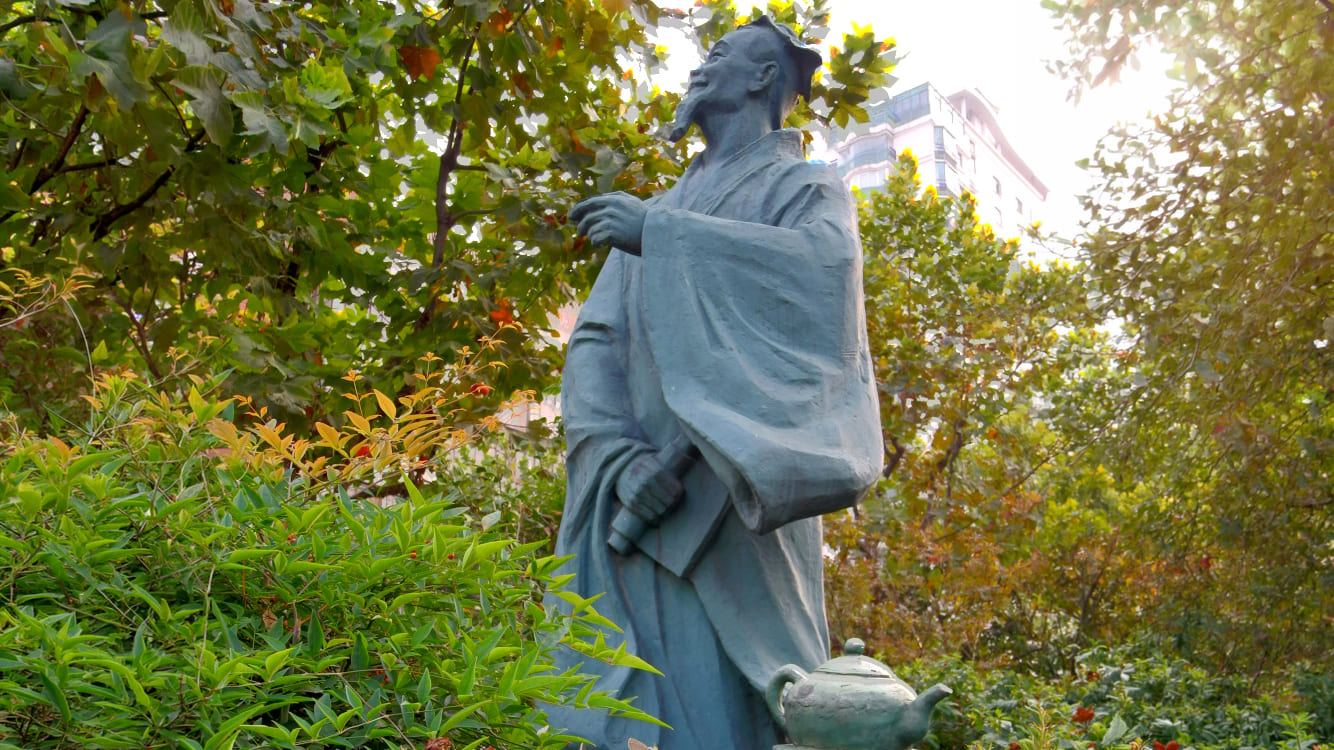
The most important treatise on tea is Lu Yu ‘s (photo) 758 Chajing, (The Tea Classic) in three volumes and ten sections. It describes in great detail the cultivation, harvesting, preparation, water (appropriate sources), objects to use, how to drink and so on.
Tea arrived in Europe thanks to the Indo-Dutch company, around 1602. In 1640, Dutch physician Nicolas Tulpius published a medicinal treatise on tea, probably inspired by the tales of sailors from the Orient. By 1655, the drink was already widespread in Parisian high society.
Two French physicians also wrote about tea: Morisset in 1648 and Jonquet in 1657. The tea toured the courts of Europe and was adopted by the Imperial Court of Russia. It first appeared in England around 1661, but it was in 1669 that the first shipment made its official debut with the Compagnie des Indes. Such was the success of tea in England that it became an economic force, provoking a “tea war” with the Middle Kingdom.
The enormous financial stakes involved meant that special ships had to be built to bring the precious tea harvests to Europe and America as quickly as possible. Originating in China, tea is now the most widely drunk beverage in the world after water.
In China, there are as many varieties of tea as there are producers, from 8,000 to 9,000 depending on the source. Chinese teas are classified into six families:
– Yellow tea
– The white
– Green tea
– Wulong tea (Oolong)
– Red tea, called black by Westerners
– Black tea
Each family develops into a sub-family of varieties. The equivalent of grands crus are called Grands Jardins, which can be found in every family. In general, these Grands Jardins come from small-scale productions, some of which were reserved for the Imperial Court and are still used today by the government.
Red teas are so called by the Chinese because of the color of the infusion (it’s our black tea). Wulong is fermented between 15% and 60%, and those fermented at 15% are known as “blue-green”. They are tasted in Gong Fu Cha. White and yellow teas are rarer and more subtle, prepared with care.
Other teas, such as Pu Er, are in great demand today; they can be kept and improve for many years, as can Sheng Cha, whose fermentation has not been stopped. Pu Er Sheng Cha are the origin of tea and Chinese pharmacopoeia, imperial tributes traded by the Court to the Mongols in exchange for horses. Caravans traded from Tibet to the Persian Gulf along the famous Tea Routes.
Like our wines and spirits, tea is a knowledge, a culture. All the teas we present are teas whose origins we know exactly. As well as terroirs, picking times, processing, transport and storage. Two trips a year are devoted solely to our tea supplies. Our catalog therefore presents our teas with their picking times.
AN HUA HONG CHA
KEEMUN HONG MAO FENG - 100g
Bag Batch 2 discovery
PU ER MARS 2017
ZHENG SHAN XIAO ZHONG - 100g
JIN YA HONG CHA-GOLDEN SPIKES - 100g
PU ER MARS 2016
PU ER MARS 2015
Pu Er MARS 2014
PU ER MARCH 2012 100g
YUNNAN A LA ROSE
SHUI XIAN 3rd grade
ORIENTAL BEAUTY - 100g
LAO CONG SHUI XIAN - 100g
ROU GUI - 100g
JIN XUAN - 100g
HA LI SHAN - 100g
LAPSANG SOUCHONG 1st grade
PU ER MARCH 2013 500 YEARS AGO
PU ER MARCH 2015 500-year-old tea trees
PU ER MARS 2019 THEIERS 500 ANS
CUI YU - 100g
DONG DING - 100g
PU ER MARS 2009
PU ER VRAC MARS 2004 - 100g
Sachet lot 1 discovery
Coffret rouge 3 thés de Chine
Grands Crus discovery box
PU ER MARS 2014 Mini galette
PU ER MARCH 2009 500 years
PU ER MARS 2017 500-year-old tea trees
MINI TUO CHA box
TUO CHA ROUGE
PU ER March 2015 100g
PU ER MARS 2012
BI LUO CHUN - 100g
DAO REN MAO FENG - 1000g
LONG JING 1st grade - 100g
GOLDEN YUNNAN - 1000g
YUNNAN IMPERIAL - 100g
Coffret 4 tasses De Hua
Zhong rouge
Pot en argile marron 500g
5202FAN61
THEIERE PORCELAINE 25cl
Plateau Gong FU cha
Boîte en fonte de 100g
Glass jug
Wooden saucer
Lot de 7 mini tasses couleurs
5202FAN38
Mini Set de voyage
Yi Xing teapot
Théière Porcelaine céladon
Boîte en fonte de 50g
Mini tasse porcelaine
Mini plateau à thé
Verseuse céladon
"Peony" teapot Yixing
Coupelle à thé
Zhong blanc
Tasse porcelaine mate
Pot à thé céladon
Yi Xing teapot
GAIWAN POURING CUP
Mini colander
Porcelain teapot 450 cl
Tea infuser
Pot en argile sable 500g
Tasse porcelaine céladon
Petit plateau en bois ondulé
Petite théière couvercle en bambou
PU ER MARS 2013
QI LAN WUYI - 100g
Peony" teapot Yixing
5202FAN54
THE VERT GENMAICHA
PU ER SHU CHA 100g MARS 2011
PU ER VRAC MARS 2015 - 100g
PU ER MARS 2002
Grand plateau en bois ondulé
Yi Xing teapot ochre
PU ER BING DAO MARS 2011
YUN FENG MAO JIAN
LONG JING 3rd grade - 100g
IMPERIAL JASMINE - 100g
FENG HUANG DAN CONG - 100g
KEEMUN GRAND CRU - 100g
Mug
AN JI BAI CHA - 100g
DA HONG PAO, robe rouge - 100g
PU ER MARS 2019
Théière Porcelaine De Hua
THE VERT ZHU CHA - 100g
YUNNAN VERT - 100g
BI AN YUN FENG - 100g
LONG JING GRAND CRU - 100g
BAI HAO YIN ZHEN - 100g
TAI PING HOU KUI - 100g
Tasse porcelaine mate haute